Click to enlarge
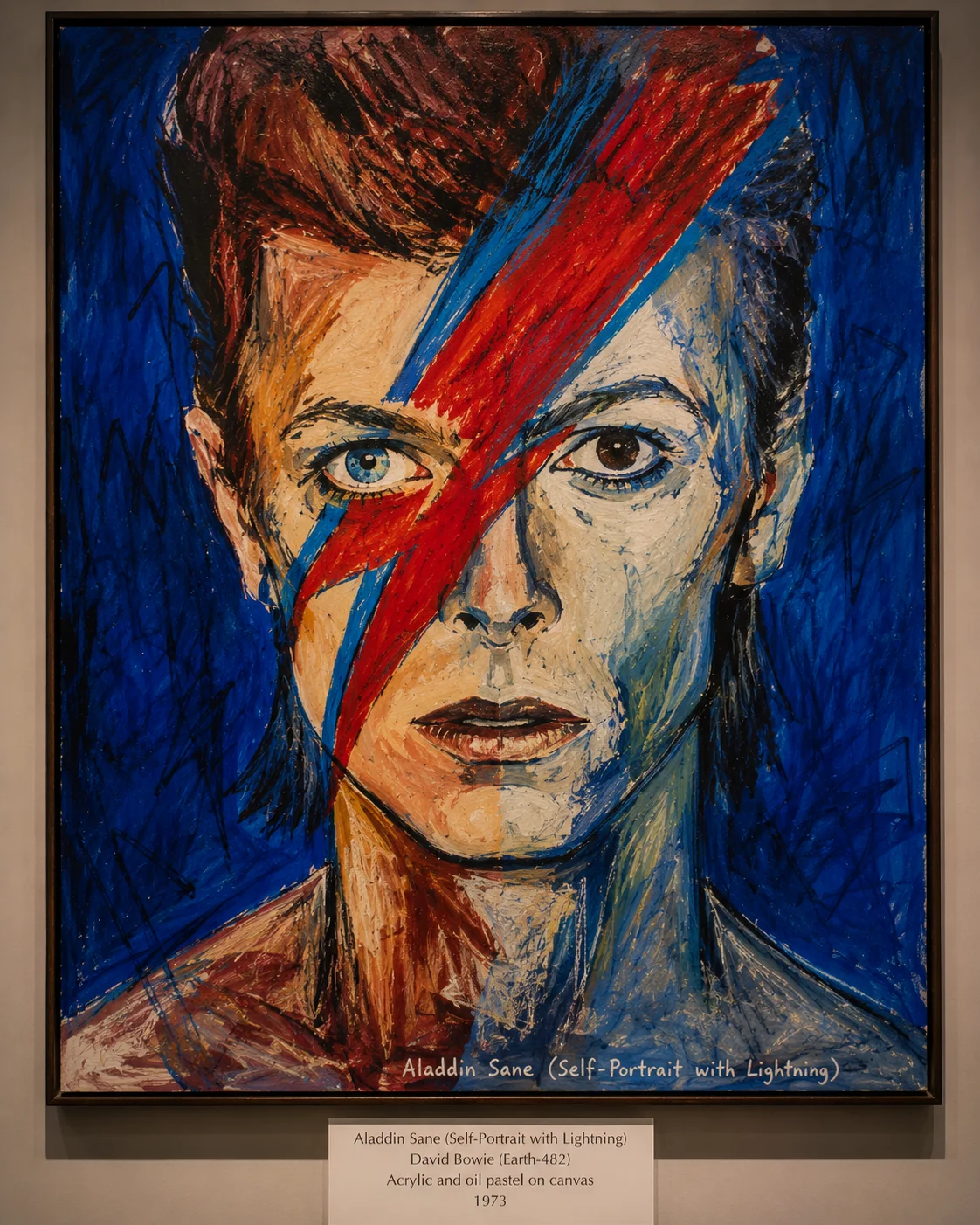
Acrylic and oil pastel on canvas · 152 × 122 cm · 1973
Aladdin Sane (Self-Portrait with Lightning)
By David Bowie — Explore the real-world artist ↗
| Universe | Earth-482 |
| Year | 1973 |
| Technique | Acrylic and oil pastel on canvas |
| Dimensions | 152 × 122 cm |
| Movement | Neo-Expressionism / Theatricalist Figuration |
About the Work
Bowie paints himself at twenty-six — young enough that the face is still becoming what it will be — with a diagonal stroke of acrylic in cadmium red and electric blue crossing from the upper right forehead to the lower left cheek. The lightning bolt. It is not decorative. It cuts the face in two, and the two halves are painted differently: the left in warm flesh tones, recognisably representational; the right in cooler, flatter marks, almost graphic. The eyes are the painting's centre of gravity — one blue, one the darker, dilated eye that in our world Bowie had from a childhood fight. Here it is simply the eye that sees differently. The background is a deep, saturated cobalt that pushes the face forward with an almost aggressive luminosity. The title is written in Bowie's distinctive hand along the bottom edge, in white paint, very small: 'Aladdin Sane'. Below that, in even smaller letters: '(Self-Portrait with Lightning)'.
The Artist in Earth-482
In Earth-482, Bowie's painting career passed through a series of named periods as deliberate and theatrically conceived as the musical personas he never had. The 'Ziggy' paintings of 1972–73 — raw, almost violently coloured — gave way to the 'Aladdin' series, in which he introduced a recurring motif: a diagonal lightning bolt across the face of a figure. The figure was always himself, or always some version of himself. Critics argued about whether the lightning was a scar, a mask, a brand, or a wound. Bowie declined to say. His 'Berlin period' (1976–79) produced the most austere and formally demanding work of his career: large canvases in near-monochrome, the figure barely legible. He returned to colour in the 1980s and continued painting until the final weeks of his life. His last series, completed in January 2016, was called 'Blackstar'.
Universe Context
A universe in which the BBC rejected David Bowie's pitch for 'Space Oddity' in 1969, before the song was even recorded. Without that breakthrough, his music career — already precarious — collapsed entirely. He enrolled at Croydon College of Art the following year. The British art world of the 1970s and 80s was consequently shaped by a figure of extraordinary theatrical intelligence and an obsession with identity as performance. His influence on a generation of British painters rivals, in this universe, the influence he had on musicians in ours.