Our Story
History of the
Heterocosmic Museum
The Heterocosmic Museum of Art did not begin as an institution. It began as a question: if other universes exist, and if art is made in them, where does it go?
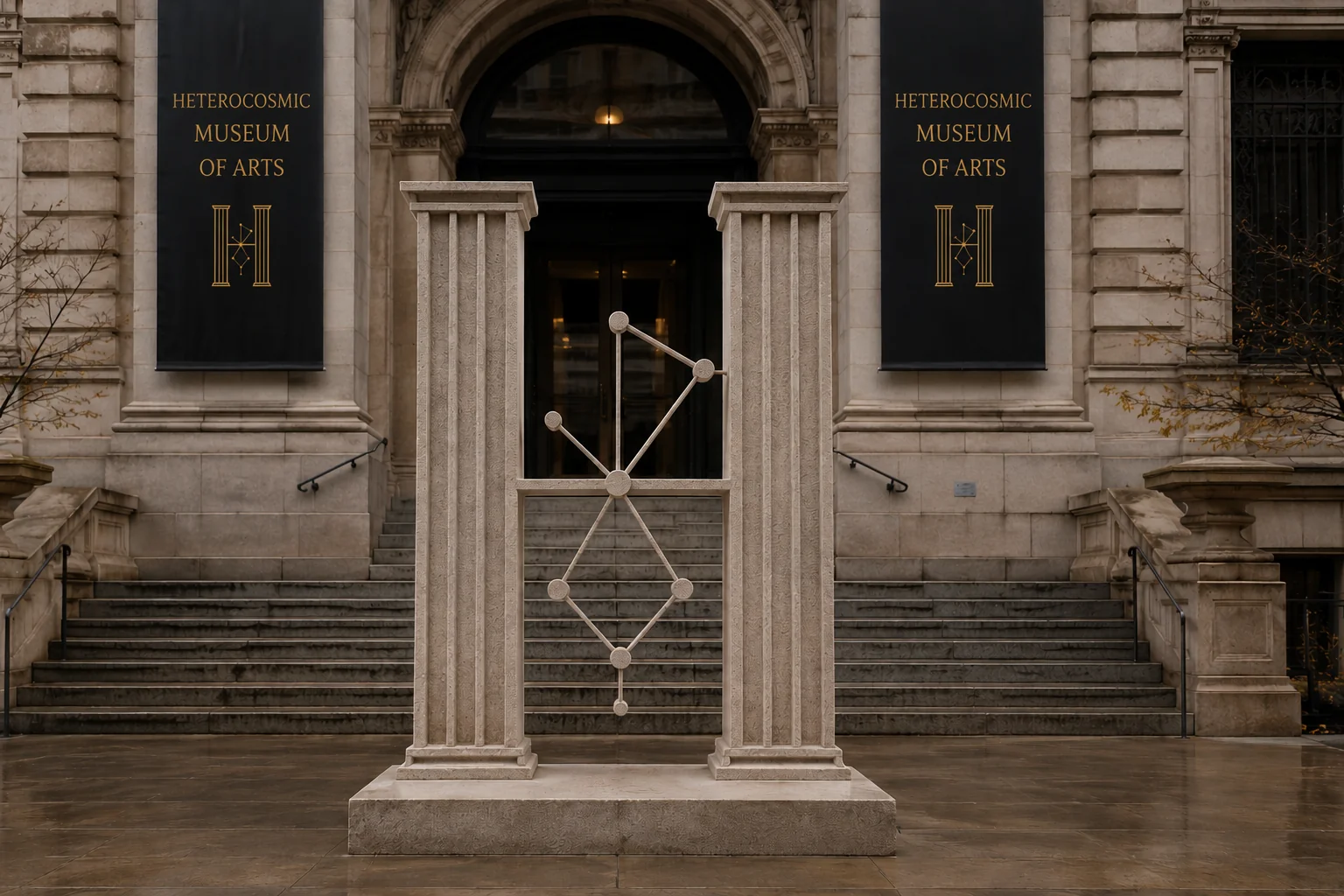
Click to enlarge
Founding — 2024
The museum was founded in 2024 by a small group of researchers who had spent the previous decade working at the intersection of theoretical physics and art history. Their starting premise was straightforward: if the multiverse is real, and if creative genius is a property of the individual rather than of history, then works of extraordinary quality must exist in other timelines — works that our world has no record of, made by artists our world knows by different names, or under different circumstances, or not at all.
The founding team secured a first location — a converted industrial building on the edge of the city — and began the painstaking work of building what would become the museum's proprietary acquisition technology. For the first two years, no works entered the collection. The team was mapping universes, documenting divergences, learning to distinguish a timeline where a major artist died young from one where the same artist survived, changed medium, or produced an entirely different body of work.
First Acquisitions — 2025
The first confirmed acquisition took place in early 2025: a large-format canvas by Aleksandr Deyneka, produced in a universe designated Earth-223, where the Soviet Union persisted through the 1980s in a more decentralised form. In Earth-223, Deyneka lived well into the 1970s and his late work — monumental in scale, warmer in palette than his earlier canvases — represents a body of art unknown to our art history entirely. Glorious Worker was the first of his Earth-223 paintings to cross into our world.
A second major acquisition followed later that year: a painting by Edward Hopper, acquired from Earth-712, a timeline in which Hopper spent his middle years in Paris rather than New York. The influence of French post-impressionism on his otherwise unmistakable sensibility produced work of startling intimacy. Automat at First Light entered the collection in the autumn of 2025 and became, almost immediately, the most discussed work in the museum.
Growth and Recognition — 2026
By 2026 the collection had grown to encompass works from several documented universes, spanning four centuries of art history across timelines diverging at moments as distant as the early Renaissance and as recent as the mid-twentieth century. The museum moved to its current premises — a purpose-built space designed to display works of varying scale without compromising on light, silence or the quality of encounter that serious painting demands.
The curatorial team expanded. A permanent research division was established to maintain continuous surveillance of newly documented universes and to develop the historical and art-historical profiles that make acquisition possible. The museum also began publishing the first scholarly accounts of its methodology — not the technical details of the acquisition process, which remain proprietary, but the intellectual framework: how a universe is chosen, how an artist's alternate biography is reconstructed, how a work is authenticated once it arrives.
Recognition came, as it tends to, slowly and then suddenly. The museum became a point of reference not only for those interested in the multiverse as a scientific reality but for anyone who had ever wondered what more the history of art might have contained had history itself gone differently. That turned out to be a very large audience.
Today
The Heterocosmic Museum of Art continues to acquire, to research and to exhibit. The number of documented universes grows each year. The number of artists whose alternate careers have been mapped in sufficient depth to support acquisition grows with it. The collection that exists today represents a fraction of what will eventually hang on these walls.
The museum's founding question — if other universes exist, where does the art in them go? — has become a founding answer: here.
The Collection Today
Works spanning multiple universes, from the early Renaissance to the twentieth century, selected for formal quality, historical significance, and the depth of what they reveal about the worlds that produced them.
Looking Ahead
The work of acquisition is not finished. New universes are documented continuously, new artists' alternate biographies are mapped, and the collection grows — slowly, deliberately, one extraordinary work at a time.