Research & Technology
How the
Museum Works
The acquisition of works from parallel universes is not a metaphor. It is a process grounded in a specific body of theoretical and applied research, developed by the museum's scientific team over several years. This page documents that process as accurately as institutional disclosure allows.
Theoretical Foundation
The Reticulum
On the geometry of parallel universes — and why the word "parallel" was always wrong
The standard model of the multiverse, as it appears in the scientific literature of our universe, describes parallel universes as exactly that: parallel planes of existence, equidistant, never intersecting, running alongside one another through an abstract higher-dimensional space. It is a tidy model. It is also, as our research has demonstrated conclusively, incorrect.
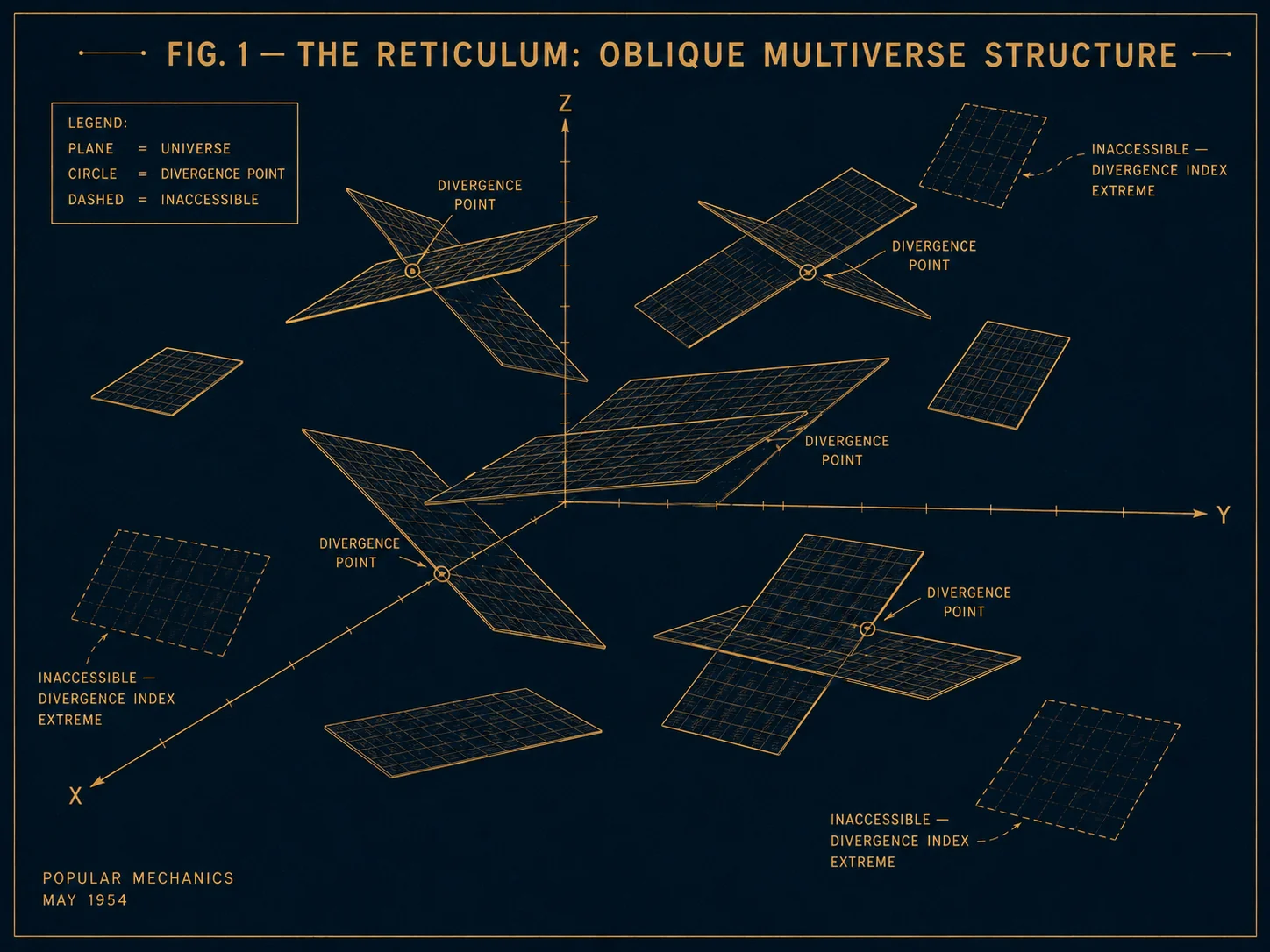
The correct model — which the museum's scientific team developed between 2019 and 2022 and which we have named Reticular Cosmology, or the Reticulate Divergence Model — describes the multiverse not as a stack of parallel planes but as a three-dimensional (and, in the temporal dimension, four-dimensional) web of oblique surfaces. Each universe occupies a plane, but no two planes are truly parallel. Each is inclined relative to every other by a measurable angle, which we call its divergence index.
The consequences of this model are significant. Where two planes are inclined at compatible angles, they will, at some point in their respective geometries, make contact. These contact points are not constructed or engineered — they are properties of the structure itself, emergent intersections in a web of surfaces that has always been there. We did not invent them. We learned to find them.
The name we have given to this web is The Reticulum. In Latin, a diminutive of rete: a net. In anatomy, a fine network of fibres. In astronomy, a southern constellation marking the eyepiece reticle of an early telescope. We chose the name for all three reasons. The structure is net-like, fibrous, and above all a lens — the instrument through which the museum reads what is otherwise invisible.
The Fourth Dimension
In three spatial dimensions, two inclined planes will intersect along a line. The addition of the temporal dimension complicates this: a Divergence Point is not merely a location in space but an event in time. Two universes may be tangent at a specific spatial coordinate and at a specific moment in their respective temporal sequences. This means the museum does not simply choose where to conduct an acquisition — it must also determine when, within the target universe's history, the contact window is open.
It also means that the same universe may, over the course of cosmic time, become accessible from different temporal positions. A universe whose fourteenth century is currently unreachable may have a nineteenth century that is not. The museum's acquisition archive reflects this: several universes appear multiple times, documented at different historical moments.
Inaccessible Universes
Not every universe in the Reticulum is reachable. Some planes carry divergence indices so extreme — inclinations so far from those of our universe's local web — that they never form contact points with any surface accessible to us. The museum's detection instruments can identify these universes; their signatures appear clearly in the data. We can map them, assign them catalogue numbers, note what little is inferrable about their structure. We cannot enter them.
This is, in our judgement, the most intellectually honest thing we can say about the limits of the museum's methodology: there is more we cannot reach than we can. The Reticulum is vast. Our position within it is fixed. What we have acquired represents a small corner of a structure whose full extent is, for practical purposes, infinite.
Key Concept
Divergence Points
The intersections at which acquisition becomes possible
A Divergence Point is a four-dimensional event: a moment in which two universes — each inclined relative to the other at a measurable divergence index — make contact across both spatial and temporal coordinates. At a Divergence Point, the boundary between the two universes thins to a depth that the museum's instruments can measure and, under the right conditions, cross.
Divergence Points are not stable by nature. Their duration varies: some persist for hours, some for days, a small number for months. Several of the museum's most significant acquisitions were made through windows that lasted less than seventy-two hours. Others — particularly in universes whose divergence index places them in close geometric proximity to our own — have remained open long enough to permit extended documentation and multiple retrieval operations.
The name Divergence Point is, technically, a misnomer we have retained for historical reasons. When the museum's research team first identified these intersections, they were understood as points where universes had diverged from a shared origin — the moment of historical branching made geometrically visible. Subsequent research has shown this interpretation to be oversimplified: the contact between two planes at a Divergence Point is not necessarily located at the moment of their historical divergence. It is simply the point where their respective geometries happen to touch. The name, however, had already entered the team's working vocabulary, and we have kept it.
The Instrument
The Cyclorama
The museum's primary research instrument — and the floor on which it operates
The second floor of the museum building — below the ground floor, accessible only to credentialed members of the research and operations staff — houses the instrument through which all acquisition work is conducted. This floor is not open to visitors and is not included in any public map of the building. Its existence is acknowledged here because the museum considers transparency about its methodology a curatorial obligation. Its precise dimensions, layout, and operational parameters are not disclosed.
The instrument is called The Cyclorama. The name derives from the panoramic cylindrical paintings of the nineteenth century — works that surrounded their viewers on all sides, placing them at the centre of a total visual field. The Cyclorama functions analogously: from its operating position, a trained researcher can observe, simultaneously, the divergence signatures of multiple universes in the local Reticulum. It does not look outward. It looks, in every direction at once, inward — at the geometry of the web in which our universe is embedded.
The Cyclorama is a single integrated system composed of five discrete instruments, each responsible for one phase of the acquisition process. They are described below in operational sequence.
The Five Instruments
Components of the Cyclorama
I
The Alidade
Detection
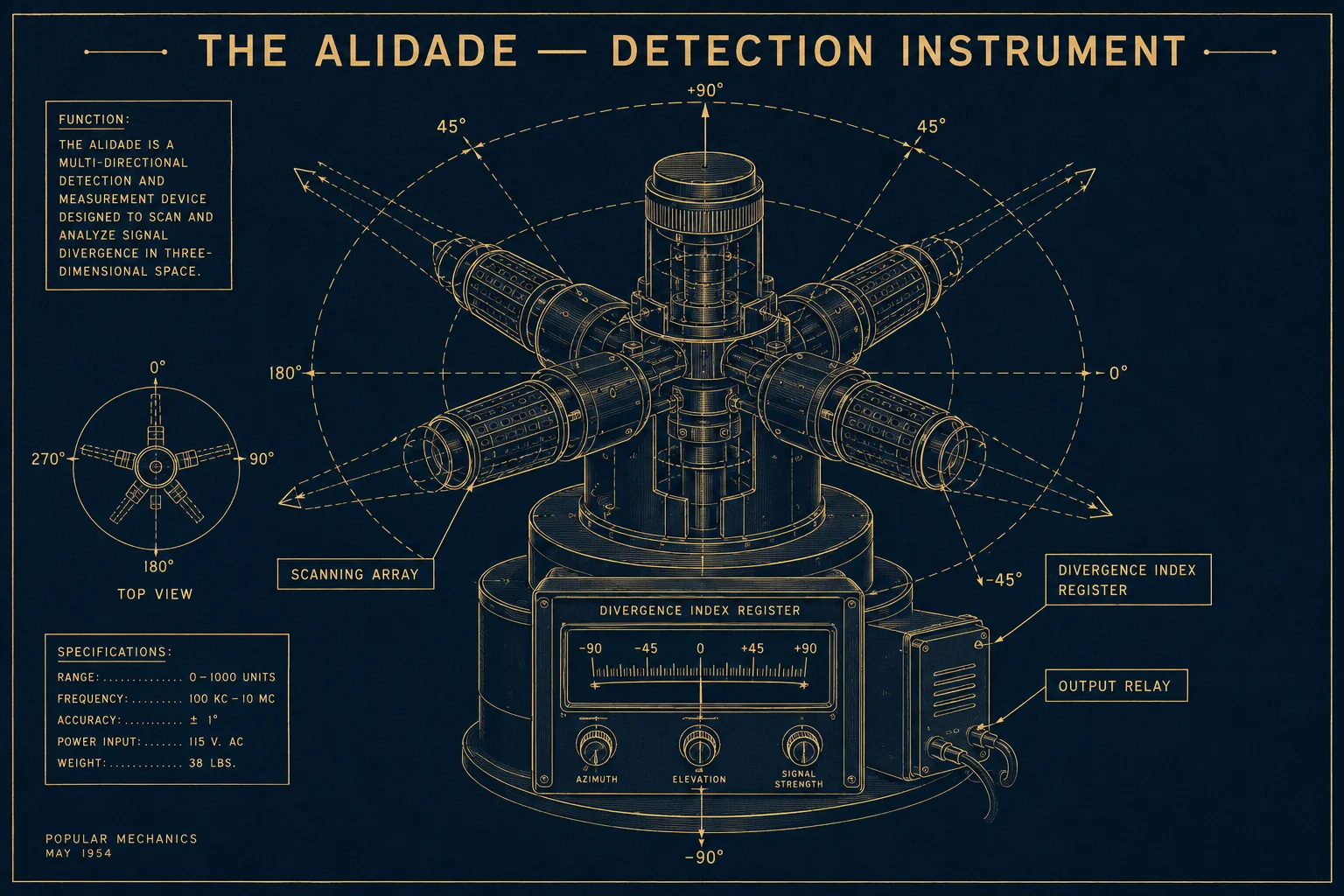
The Alidade is the Cyclorama's primary sensing instrument. Named after the sighting rule used in classical surveying to measure angular distance, it performs a continuous scan of the Reticulum's local geometry, logging the divergence index of every plane within detection range and flagging any contact events — actual or approaching — for further analysis.
The Alidade does not interpret what it finds. It measures and records. Its output is a continuously updated divergence map: a representation of the local Reticulum in four dimensions, showing every universe within range, its current inclination relative to our own, and the coordinates of any active or predicted Divergence Points. This map is the starting point of all acquisition work.
The instrument can also detect universes that lie beyond any current or predicted contact window — the inaccessible planes noted in the Reticulum section above. These appear in the divergence map as catalogue entries without acquisition flags. The museum's research archive currently holds records for several hundred such universes, none of which have ever been entered.
II
The Ephemeris
Anticipation
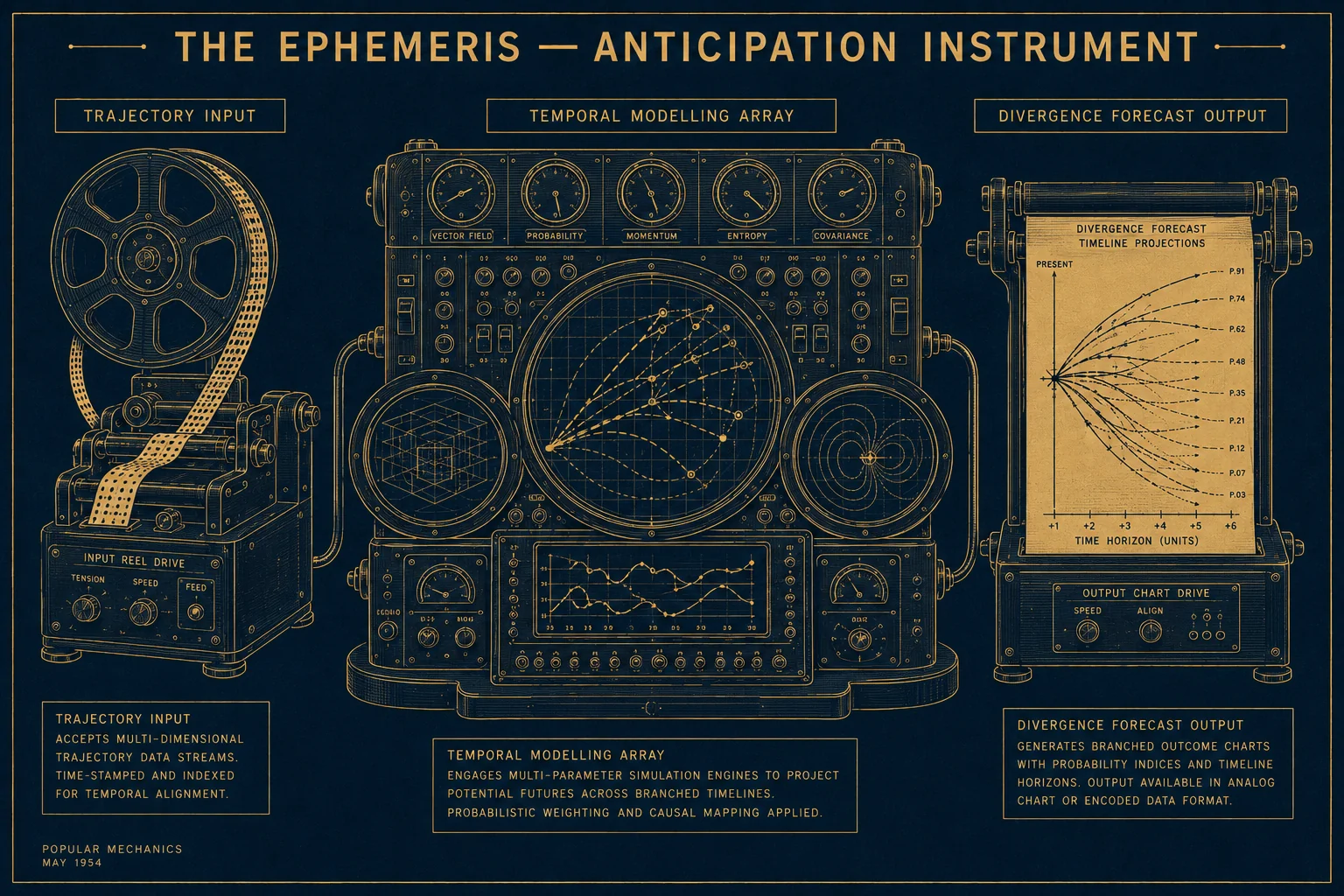
In classical astronomy, an ephemeris is a set of tables predicting the future positions of celestial bodies. The Cyclorama's second instrument takes its name from this tradition. Where the Alidade reads the current state of the local Reticulum, the Ephemeris models its future states — projecting the movement of oblique planes through time and calculating when and where contact events will occur.
The Ephemeris works by extrapolating the divergence trajectories logged by the Alidade. Because the Reticulum's geometry changes slowly — the drift of universe-planes relative to one another is measured in degrees per century — its near-term predictions are highly reliable. Divergence Points can be anticipated months in advance; in several documented cases, years. This advance notice allows the museum to conduct preliminary research into the target universe before the acquisition window opens: its history, its artistic culture, its divergence from our own timeline.
Long-range predictions are less certain. The Ephemeris currently produces reliable forecasts for windows opening within approximately fourteen months. Beyond that horizon, the compounding of small modelling errors makes specific predictions unreliable, though broad structural patterns in the Reticulum remain legible much further out.
III
The Fixative
Stabilisation
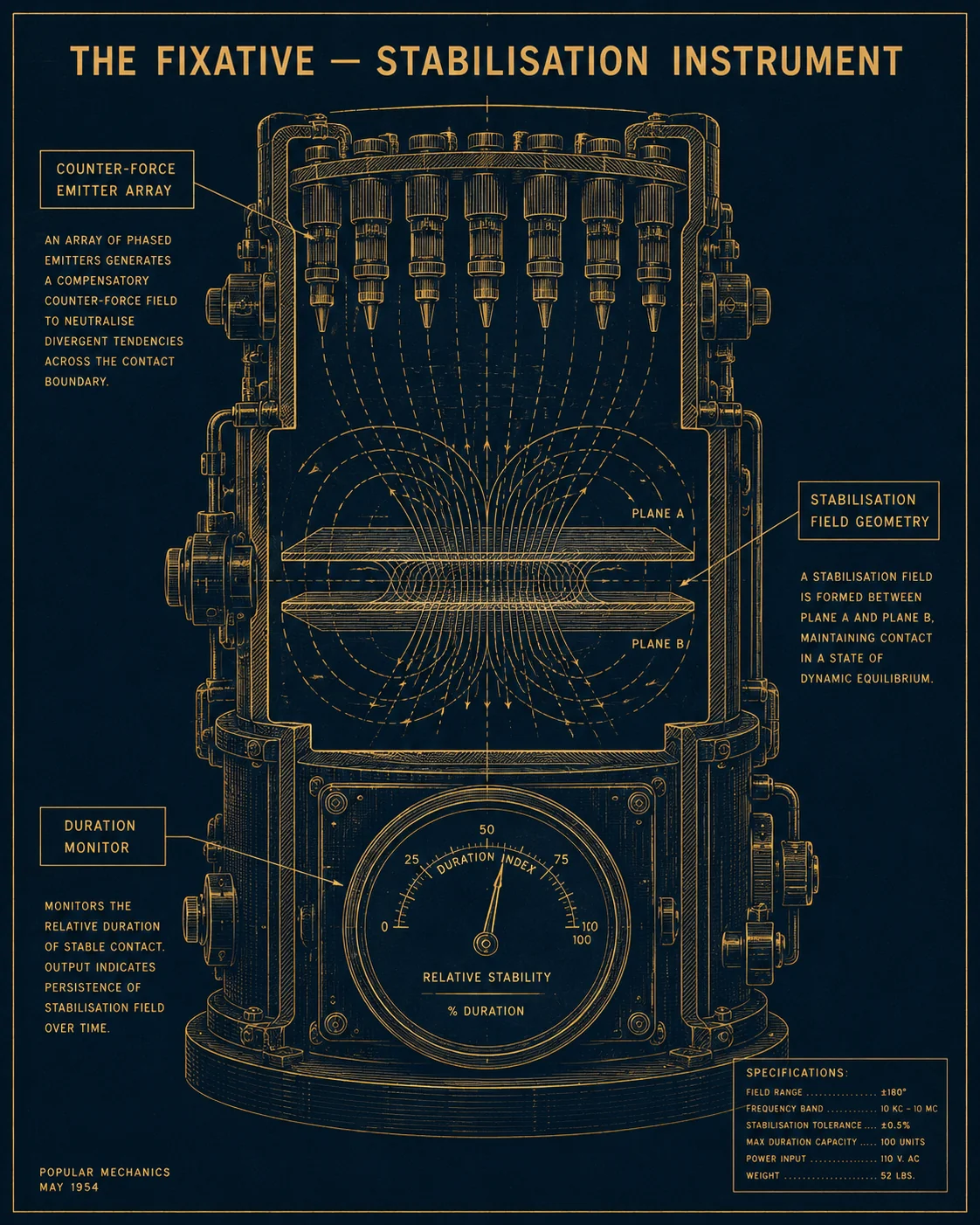
In the studio, a fixative is a solution sprayed onto a fragile drawing surface — charcoal, pastel, graphite — to arrest its disintegration. It preserves the work in its current state, holding its particles in place against disturbance. The Cyclorama's third instrument takes this name because it performs an analogous function on the geometry of a Divergence Point.
A Divergence Point, left to its own dynamics, will open and close on a schedule determined by the relative motion of the two planes in contact. The Fixative intervenes in this schedule. By introducing a precisely calibrated counter-force at the contact boundary, it can extend the duration of an open window — not indefinitely, and not without cost, but enough to allow operations that a naturally brief window would not permit.
The Fixative cannot open a window that is not naturally forming. It can only extend one that is already present. This is not a limitation the museum intends to work around: the principle that acquisition must operate through naturally occurring contact points, and not through artificially forced boundary breaches, is a founding constraint of the museum's research ethics.
IV
The Clinamen
Influence
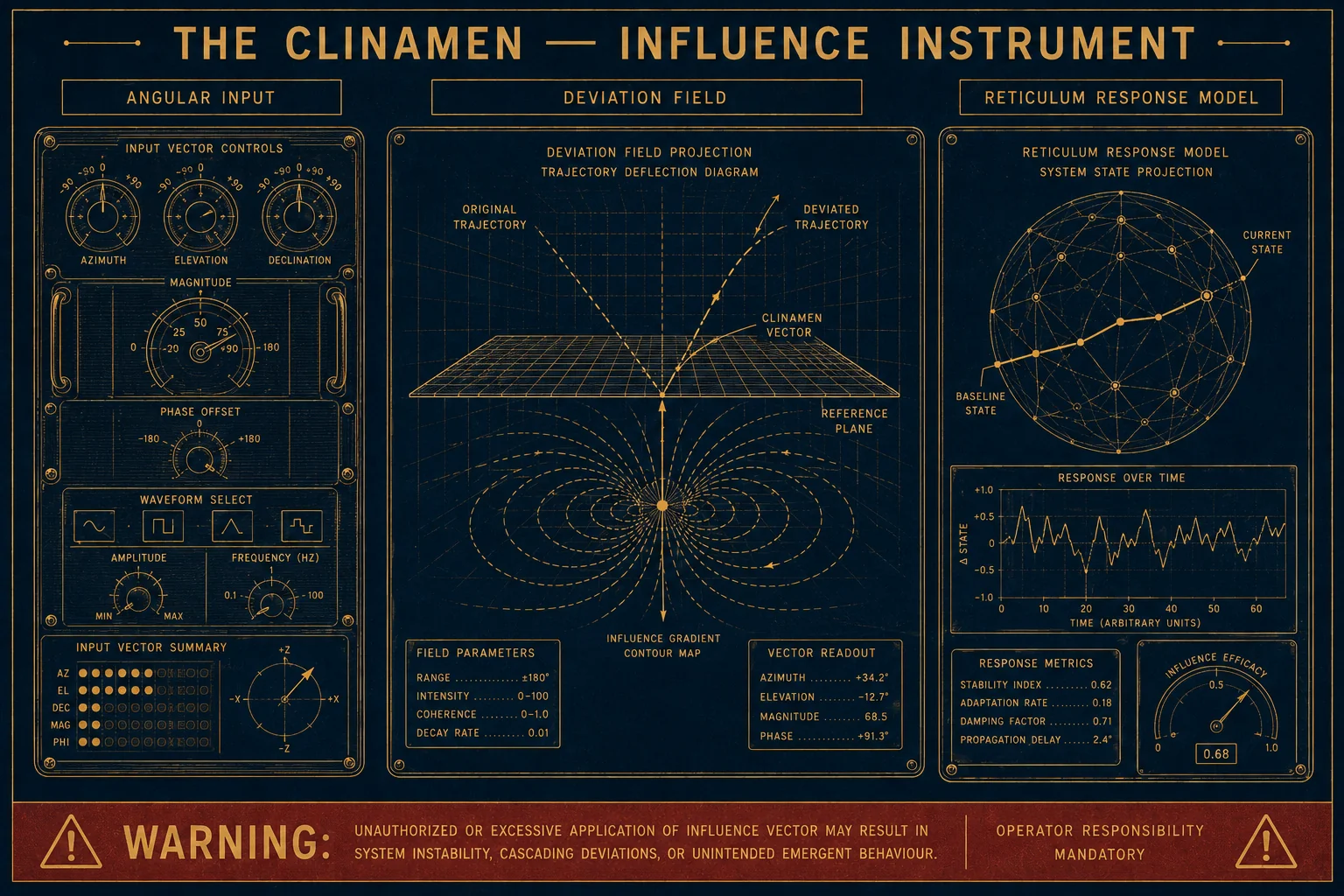
The philosopher Lucretius, writing in the first century BCE, described the movement of atoms as a perpetual downward fall — and noted that the universe as we know it could not have formed from parallel falling lines alone. Something had to swerve. He called this swerve the clinamen: the infinitesimal, unpredictable deviation that introduces variety into a deterministic system and, from that variety, generates everything.
The Cyclorama's fourth instrument takes its name from this concept because it does, in controlled form, precisely what Lucretius described: it introduces deliberate deviations into the divergence geometry of the local Reticulum. By applying a directed influence to the inclination angle of a target plane, the Clinamen can shift the position of a Divergence Point — moving a contact event in space, in time, or both.
The Clinamen is the most operationally powerful and the most carefully restricted instrument in the Cyclorama. Its use is logged at the level of individual micro-adjustments and reviewed by the museum's research committee. The reason for this caution is not technical but ethical: shifting a Divergence Point in one part of the Reticulum affects the geometry of adjacent planes. The museum does not fully understand the downstream consequences of large-scale Clinamen operations, and operates on the principle that it should not produce effects it cannot predict.
V
The Transit
Extraction
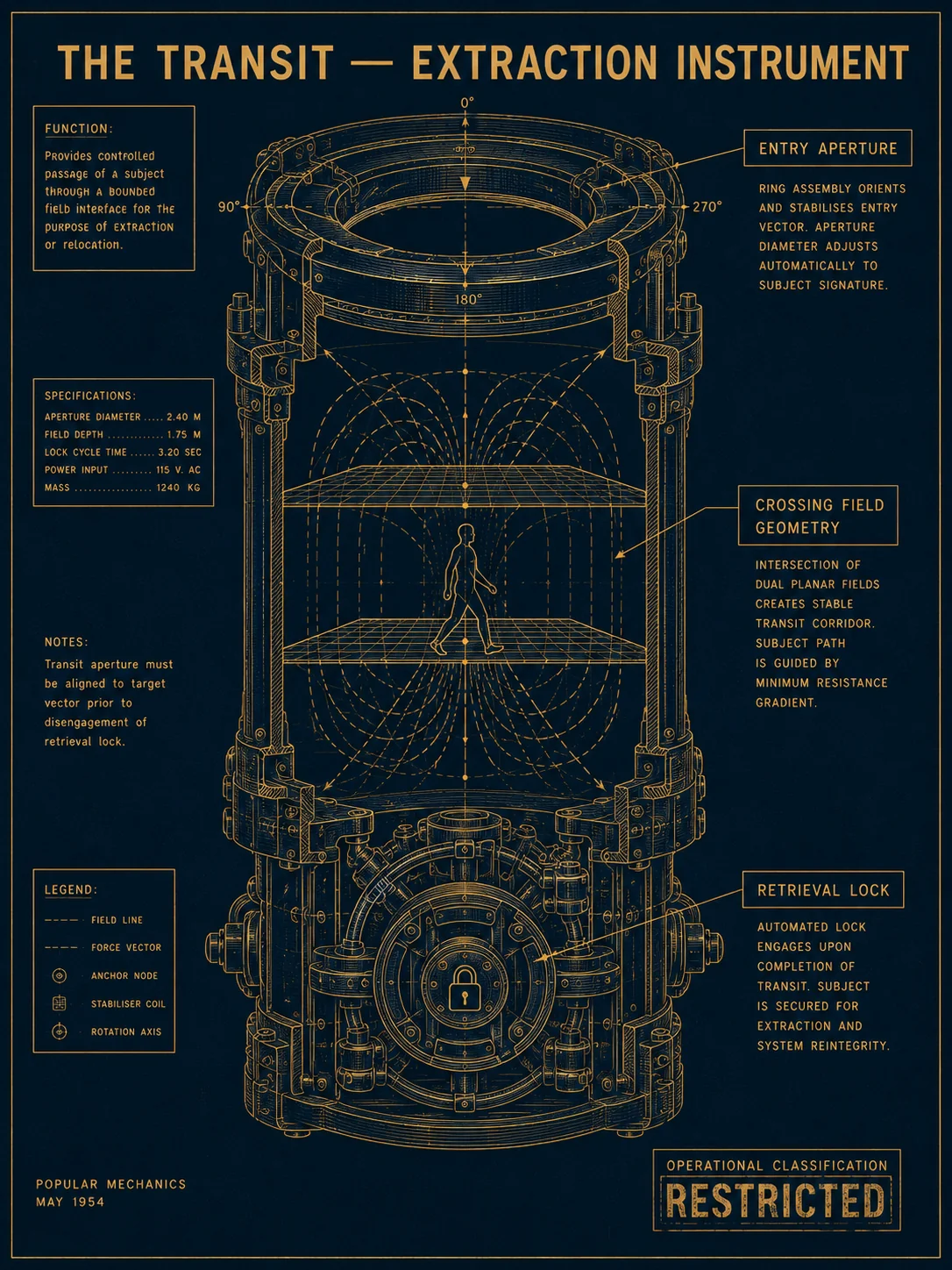
In astronomy, a transit is the passage of a smaller body across the face of a larger one — a planet crossing the solar disc, a moon passing before a giant. It is a brief event, geometrically precise, with a calculable beginning and end. The museum uses the name for its fifth and final instrument because an acquisition operation shares all of these qualities: it is a crossing, through a precisely located window, with a duration that is known in advance and cannot be extended beyond the limits the Fixative allows.
The Transit is the instrument through which a credentialed operator physically enters a parallel universe. It establishes, at the coordinates of an open Divergence Point, a passage large enough to permit the movement of a person and the work being retrieved. The operator crosses, conducts the acquisition, and returns before the window closes. What is brought through the Transit enters the museum's collection intact: it is, at the moment of crossing, exactly what it was in its universe of origin.
Transit operations are classified by window type, operator certification level, and target universe risk index. The museum's operational records, which are maintained in full, are not publicly disclosed. What can be said is this: every work currently in the collection arrived through a Transit operation conducted by a member of the museum's trained acquisitions team, and every operator who has conducted a Transit has returned from it.
The Process
From Detection to Acquisition
How a work moves from an unknown universe to these walls
The acquisition of a work begins not with the work but with the universe. Before any Transit operation is authorised, the target universe must be fully documented: its point of historical divergence from our own timeline identified and mapped, its cultural and artistic history surveyed through the Alidade's passive observation capabilities, and a specific acquisition target — an artist, a body of work, a period — identified through research conducted on this side of the boundary.
This research phase typically takes between three and eighteen months. The museum does not conduct Transit operations into undocumented universes. The ethical obligation here is clear: entering a universe about which nothing is known creates risks — to the operator, and to the universe being entered — that the museum is not willing to accept.
Once the research phase is complete and a Transit window has been identified and stabilised by the Fixative, the acquisition operation proceeds. An operator enters through the Transit, locates the designated work, and retrieves it physically. The work crosses the boundary intact. On this side, it is catalogued, examined, and prepared for exhibition in the same manner as any acquisition — with the addition of a full provenance record documenting the universe of origin, the window parameters, and the operator who conducted the retrieval.
Every work in the museum carries this record. It is not displayed on the gallery label, but it exists, and it is complete. The museum considers the documentation of acquisition circumstances to be as much a part of the work's identity as its authorship or date. A painting without a provenance is an orphan. The Heterocosmic Museum of Art does not keep orphans.
For further information on the museum's research methodology, acquisition criteria, and ethical framework, consult the Museum Manifesto. For the public acquisition record, see the Collection.