
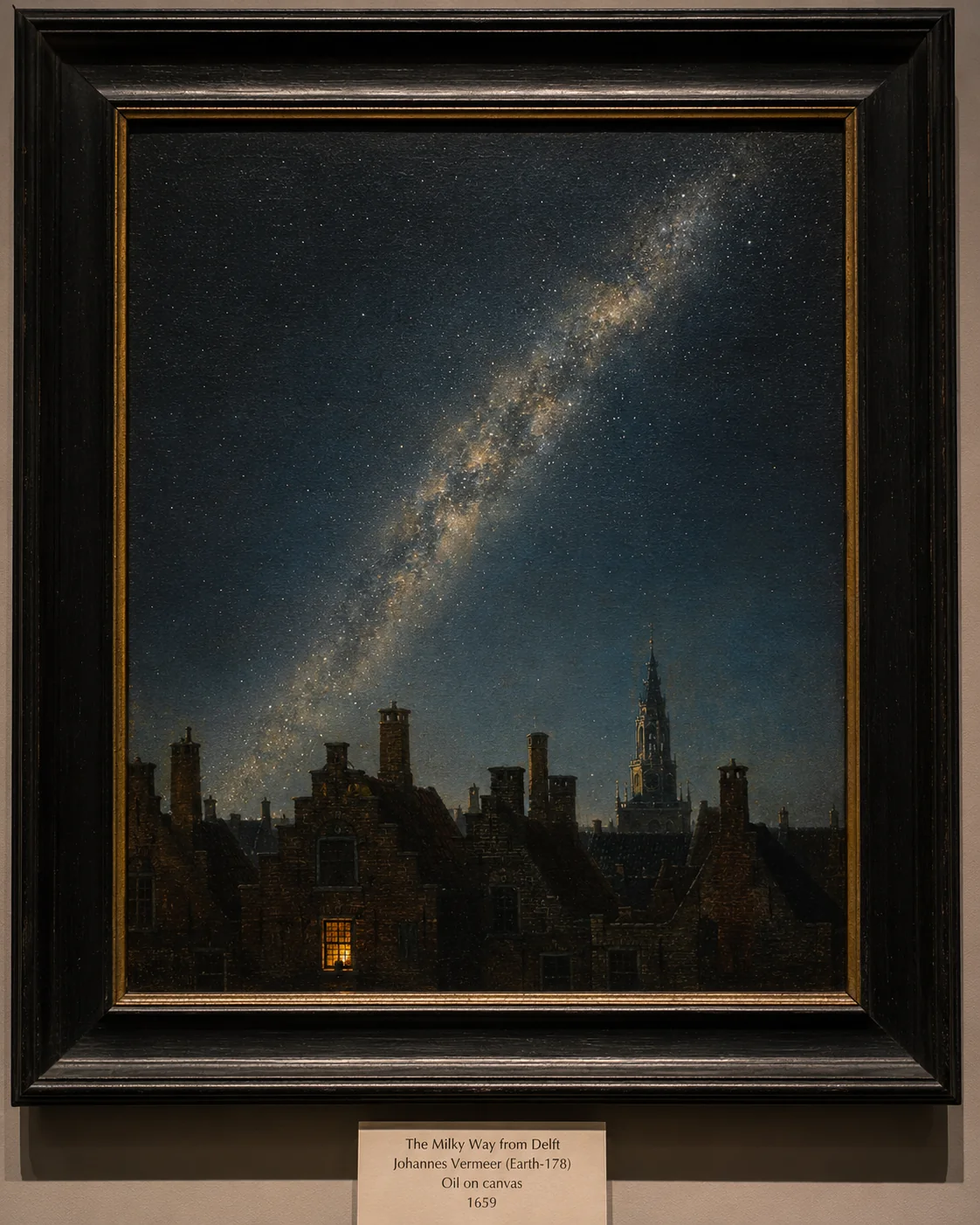
Click to enlarge
Oil on canvas · 46 × 40 cm · 1659
The Milky Way from Delft
By Johannes Vermeer — Explore the real-world artist ↗
| Universe | Earth-178 |
| Year | 1659 |
| Technique | Oil on canvas |
| Dimensions | 46 × 40 cm |
| Movement | Dutch Golden Age / Astronomical Naturalism |
About the Work
A rooftop in Delft at night, seen from above and slightly behind — the familiar red-brick silhouettes of the city's chimneys and gabled facades rendered with Vermeer's characteristic precision. Above them, filling two-thirds of the canvas, the Milky Way arches from the lower left to the upper right in a band of luminous pearl-white and warm gold, its individual stars rendered with a patience that suggests hours of observation. The sky is not uniformly dark: Vermeer has modelled it in gradations of deep blue, prussian, near-black at the corners, his usual mastery of tonal transition applied now to the void of space rather than the walls of a Dutch interior. A single window in one of the facades below glows with the warm amber of a candle — the only human light in the composition, tiny and stubborn against the cosmic scale above it. The painting is small enough to hold in one hand. The sky it contains is infinite.
The Artist in Earth-178
In Earth-178, Vermeer never painted a domestic interior. His entire career was devoted to a single obsession: the representation of celestial light. Working in close collaboration with the astronomers of the Delft Academy, he developed optical instruments of his own design to observe and record phenomena invisible to the naked eye. His paintings are small in format — he worked slowly, as always — but their subject matter is the largest imaginable. Contemporaries described his studio as a camera obscura pointed at the sky. He died at forty-three having completed thirty-one known works, every one of them a painting of the night.
Universe Context
A universe in which the optical revolution of the Dutch Golden Age extended to astronomy two generations earlier than in ours. By 1640, Delft possessed the most powerful telescopes in the world, and the city's painters — already the finest observers of light in Western art history — became collaborators with its astronomers. The resulting body of work reimagined the cosmos through the lens of Dutch domestic realism.