
Click to enlarge
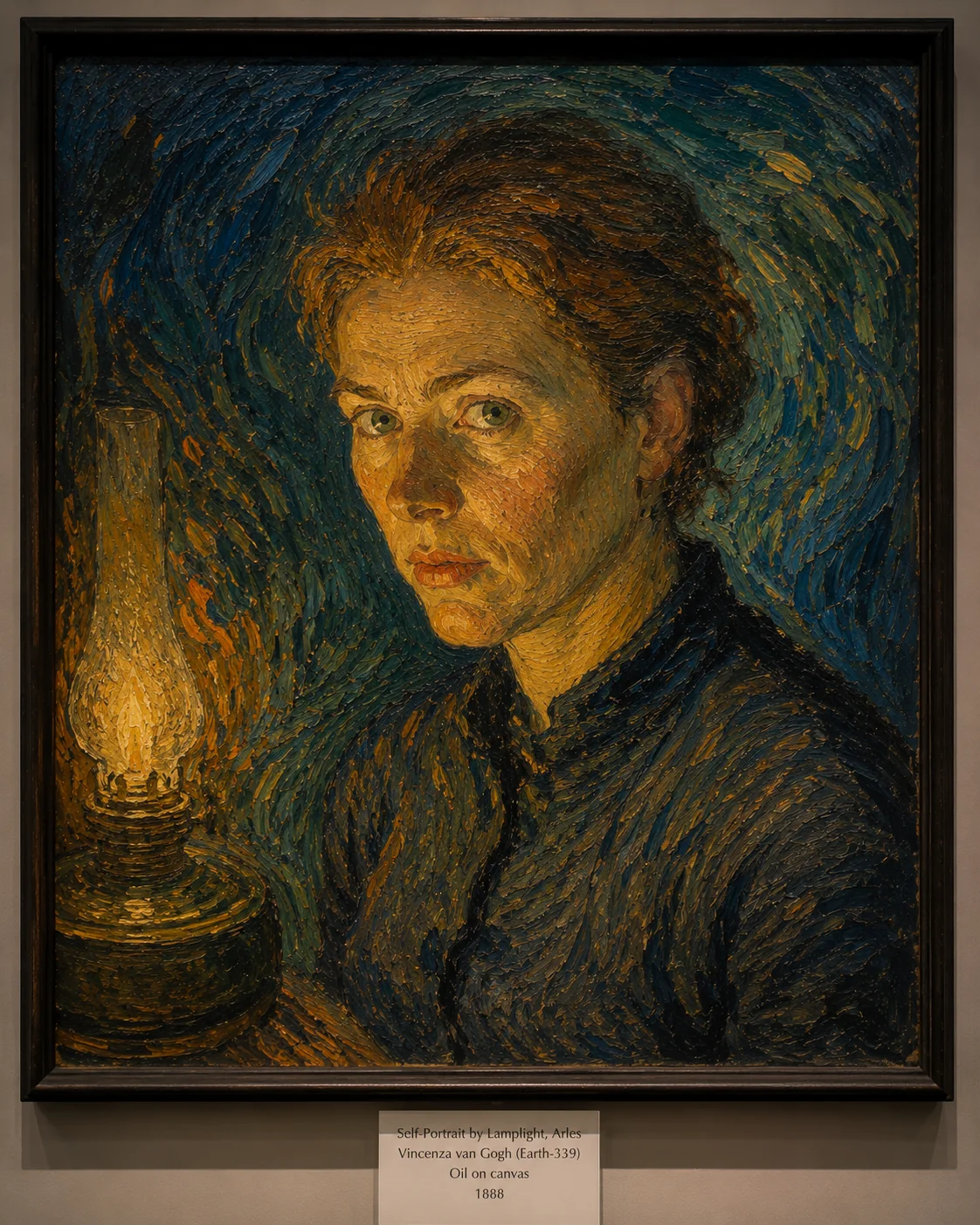
Oil on canvas · 65 × 54 cm · 1888
Self-Portrait by Lamplight, Arles
By Vincenza van Gogh — Explore the real-world artist ↗
| Universe | Earth-339 |
| Year | 1888 |
| Technique | Oil on canvas |
| Dimensions | 65 × 54 cm |
| Movement | Post-Impressionism |
About the Work
Vincenza has painted herself dozens of times, but never quite like this. The lamp on the table to her left throws its light upward across her face in a way that Rembrandt would have recognised, but the brushwork is entirely her own: each stroke visible, each one a decision, the surface of the paint alive with a physical urgency that has no equivalent in the art of her time. She looks directly at the viewer with an expression that is neither challenging nor appealing — simply present, simply there, in the same way that the lamp and the table and the darkness behind her are there. The scar at the ear is not hidden. The eyes are the same pale grey-green that appears in every self-portrait, and they carry the same quality that is so difficult to name: attentiveness, perhaps, or the particular alertness of someone who has learned not to take their own continued existence for granted.
The Artist in Earth-339
In Earth-339, Vincenza van Gogh's life diverges from her counterpart's in ways both liberating and confining. She cannot be an itinerant preacher in the mining districts of the Borinage — but she goes anyway, as a lay teacher, and the experience of witnessing poverty at close range marks her work just as it marked Vincent's. Her breakdowns are treated as a medical matter rather than a moral failing, which means she is hospitalised earlier and more often, but also that she survives. She moves to Arles in 1888, as Vincent did, but her situation there is different: a single woman of thirty-five living alone in the south of France is a figure of suspicion rather than eccentricity. She paints ferociously, in near-isolation, producing in that single year some of the most extraordinary work of the nineteenth century. She cuts her ear during her breakdown in December 1888. The scar is visible in her self-portraits until her death in 1909.
Universe Context
A universe in which several of the nineteenth and twentieth centuries' most significant male artists were born female. The consequences for their work — and for the history of art — were profound and uneven. Some found their vision constrained by circumstance; others, freed from the particular pressures of masculine artistic identity, pushed further than their counterparts in our world ever did. The art history of Earth-339 is a sustained argument about what creativity owes to biography, and what it transcends. The same logic that altered the art world in the nineteenth century continued to compound across the twentieth: the postwar American reconstruction of Japan included mandatory gender enrollment quotas in technical university faculties — twenty percent female minimum, enforced from 1947. The resulting shift in Japan's engineering workforce produced different companies, different products, different design philosophies. The Japanese games industry of Earth-339 developed from a different set of assumptions about what a game was for, and the results are legible in every title produced between 1980 and 1992.