
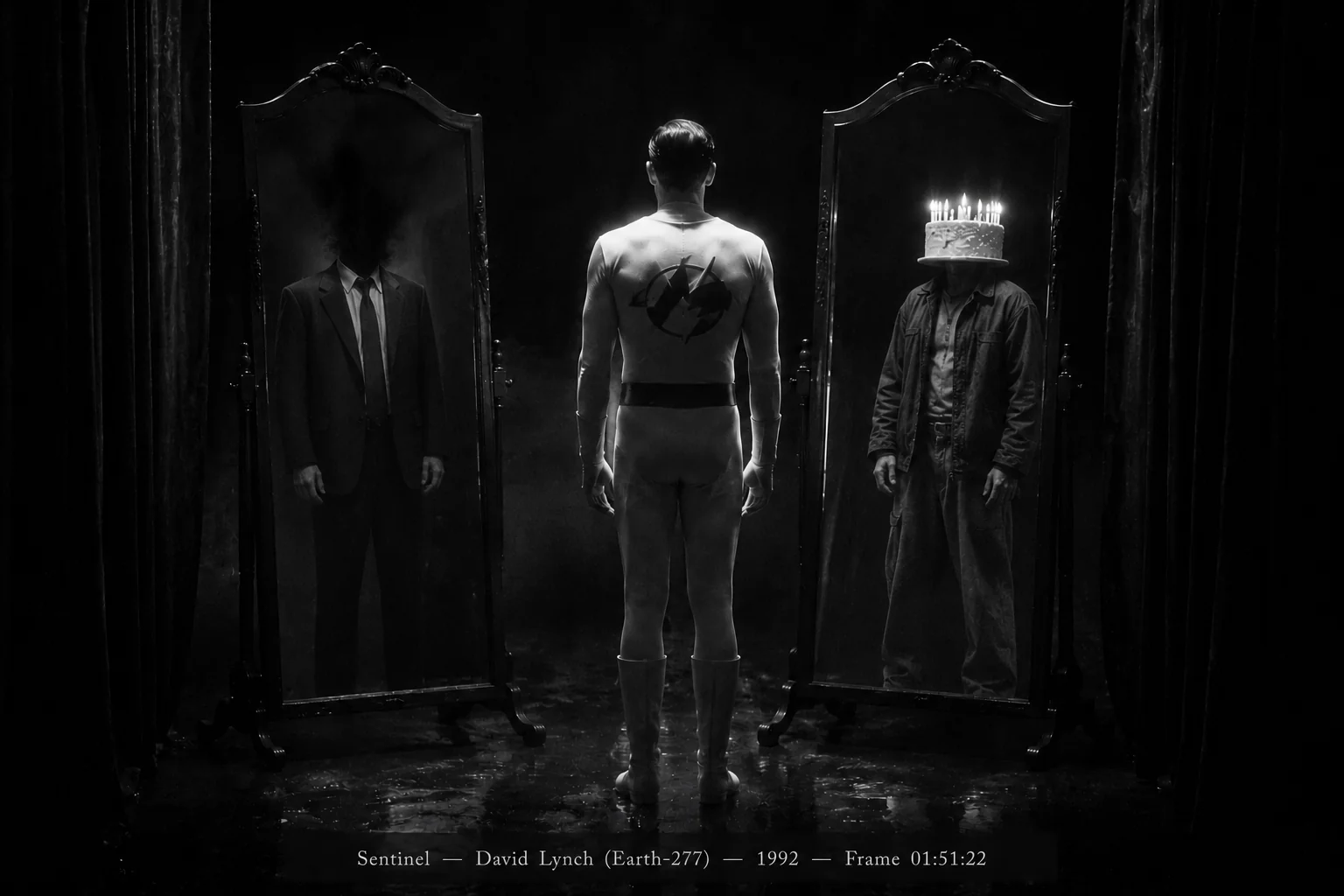
Click to enlarge
Frame 01:51:22 · 1992 · 138 min
Sentinel
Directed by David Lynch — Explore the real-world director ↗
| Universe | Earth-277 |
| Year | 1992 |
| Genre | Superhero / Psychological Horror |
| Language | English |
| Duration | 138 min |
| Exhibited frame | 01:51:22 |
| Visible in frame | Kyle MacLachlan (Clark Mercer / The Sentinel / The Other) |
The Exhibited Frame
01:51:22. A dream. The film has been signalling this for several minutes — the cuts have become wrong, the sound has retreated to a single sustained tone — but there is no title card, no dissolve, no conventional announcement. Lynch does not announce dreams. He enters them. The Sentinel stands in a room that has no identifiable walls, only darkness and two tall antique mirrors positioned so that they face each other at a slight angle, creating a triangulation in which three versions of the same man are simultaneously visible. The image is in black and white — the only sequence in the film shot this way. The Sentinel himself is in white: the costume, the only white thing in the frame, rendered in the B&W as a luminous grey, almost overexposed. He is perfectly still, facing neither mirror directly, seeing both. In the mirror to his left he sees Clark Mercer — himself in his detective's suit and tie — but where the head should be there is nothing. Not shadow, not blur. An absence. The suit is present, the collar is present, the space above it is simply empty, as if the head were a detail the dream has decided to omit. In the mirror to his right he sees The Other — in dark civilian clothes, worn and heavy, the clothes of a man who works with his hands — and where the head should be there is a birthday cake. A full-sized layer cake, white frosting, candles lit, the small flames burning with perfect stillness in a room where there is no air. The cake is not The Other's head. It is in the place where The Other's head would be, which is a different thing. Lynch holds the frame for eight seconds. The Sentinel does not move. The candles do not flicker. No one in Earth-277 has ever agreed on what the birthday cake means. Several critics have noted that this is probably correct.
About the Film
Clark Mercer is a detective in an unnamed American city. By night he becomes The Sentinel — a figure in white, alone on rooftops, a protector whose presence the city accepts the way it accepts weather. He is good. He believes this about himself with the completeness of a man who has never had reason to doubt it. There is also a series of crimes. They began eight months ago: ritual, elaborate, inexplicable, committed with a care and intelligence that Clark finds both horrifying and, in moments he does not examine, faintly familiar. The perpetrator — known in the department's files only as The Other — has left no fingerprints, no witnesses, no pattern that Clark's considerable intelligence can resolve into motive. Clark has been working the case harder than any other in his career. The film is about why. Lynch shoots Sentinel at the pace of a fever — not slow, exactly, but wrong in its rhythms, cutting before you expect and holding after you want to leave, scoring scenes of apparent calm with Angelo Badalamenti's most unsettling work since Blue Velvet. Kyle MacLachlan — Lynch's great American good man, Dale Cooper transposed into a world with capes — plays Clark with a quality that critics in Earth-277 have called terrifying in retrospect: a goodness so total, so earnest, so completely without irony, that it reads, in the film's final act, as the most frightening thing Lynch has ever put on screen. The superhero suit is white. It is the only white thing in the film.
The Director in Earth-277
In Earth-277, David Lynch made Eraserhead (1977), The Elephant Man (1980), and Blue Velvet (1986) exactly as he did in our world. The divergence came in 1989, when Warner Bros — reading his critical rehabilitation as commercial viability — offered him Sentinel with complete creative control. Lynch said later that he accepted because he had been thinking for years about a particular kind of American man: the man who believes completely in his own goodness, who has organised his entire life around the project of being good, and who is therefore the last person to recognise what lives on the other side of that belief. The superhero genre, he said, gave him the costume for that man. Everything else he provided himself. Warner Bros received the first cut in November 1991 and requested forty-seven changes. Lynch declined to make any of them. The film was released in February 1992 with an R rating, a runtime of 138 minutes, and no action sequences in the conventional sense. It earned $4.2 million in its opening weekend against a budget of $34 million. It has since been seen by a great many more people than saw it in 1992, and is now, in Earth-277, considered the definitive American film about the violence of self-belief.
Universe Context
A universe in which the commercial success of Tim Burton's Batman (1989) convinced DC and Warner Bros that the way to exploit the superhero genre was not to hire a second Tim Burton but to hire the most visionary American director available and give him complete creative control. The logic was sound; the outcome was not what they had in mind. The film they received — Sentinel (1991) — is a superhero film in the same way that Blue Velvet is a detective film: the genre is present, the conventions are present, and something is deeply, irreparably wrong with all of them. In Earth-277 it is considered one of the defining American films of the 1990s. Warner Bros did not commission a sequel.