
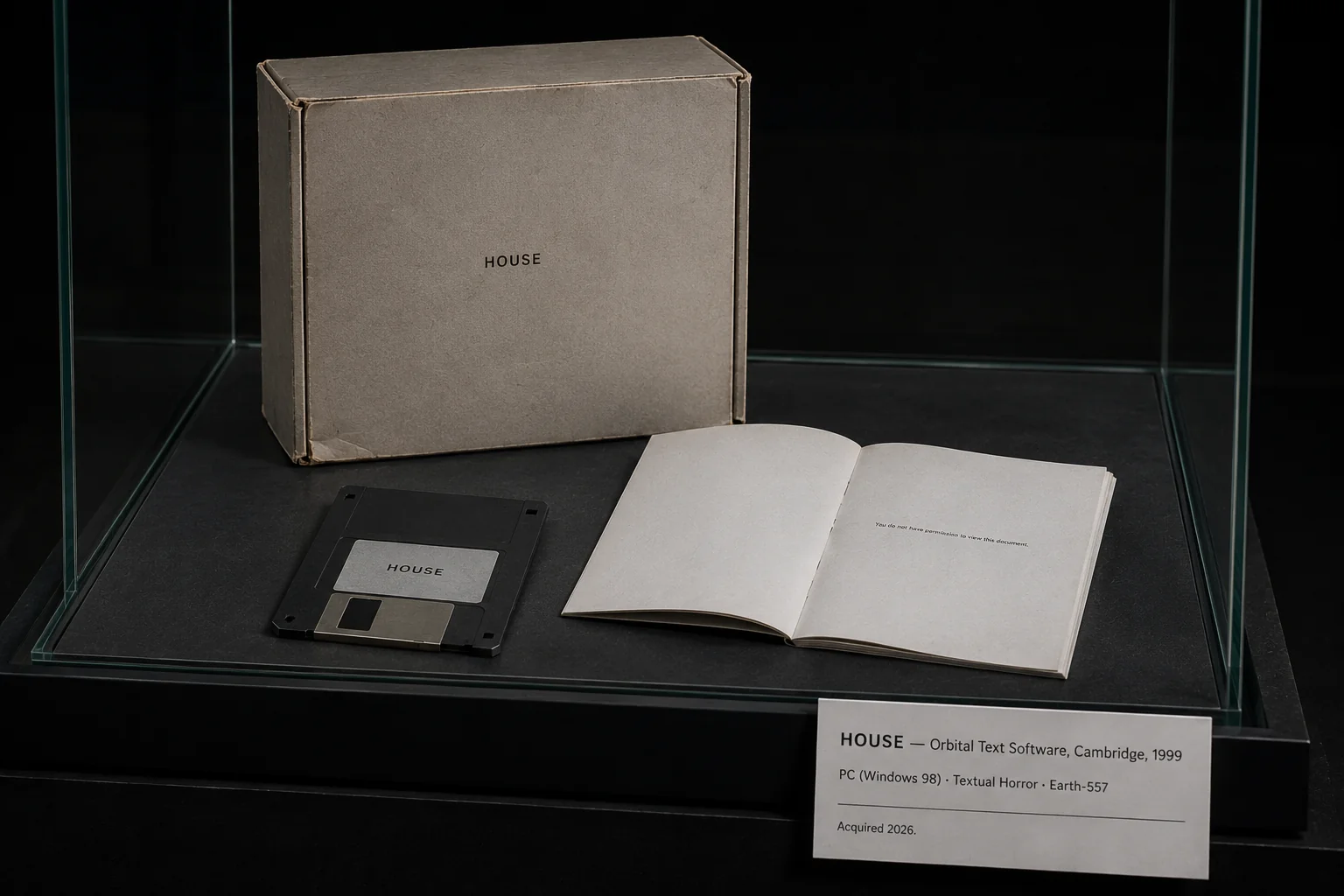
Click to enlarge
1999 · PC (Windows 98) · Textual Horror / Spatial Puzzle
House
Designed by Mark Z. Danielewski — Explore the real-world namesake ↗
| Universe | Earth-557 |
| Year | 1999 |
| Genre | Textual Horror / Spatial Puzzle |
| Platform | PC (Windows 98) |
About the Game
House is a survey.
You are given a clipboard, a steel tape measure, and a set of instructions: document the property at the given address. Room dimensions, exits, notable features. Standard procedure. The survey will be reviewed by the editor before publication.
The house does not cooperate with this ambition.
The corridors are longer in one direction than the other. A room that should open onto an exterior wall opens instead onto another corridor. The wallpaper is consistent across four rooms — off-white, a pattern of pale leaves — and then, in the dining room, it is not. Measurements recorded on entry differ from measurements recorded on exit. The editor, who appears in footnotes and marginal notes throughout the survey, corrects several of the author's observations. The corrections are not always correct.
By the time the player reaches the final room, the footnote panel at the bottom of the screen has accumulated twenty-six footnotes. Several of them reference documents that do not exist. One of them asks whether it is inside or outside the room whose measurement is zero feet by zero feet. The compass, which was functioning at the start of the survey, is no longer reliable.
House was released in November 1999 by Orbital Text Software of Cambridge. It shipped on a single floppy disk. The box was plain cardboard. The instruction booklet contained one sentence: *You do not have permission to view this document.* The game sold poorly on release and found, in the following years, the audience it deserved.
The author of the survey is not named. The editor is not named. The house is not located.
The Designer in Earth-557
In Earth-557, Mark Z. Danielewski was born in New York in 1966. His father, Tad Danielewski — in our universe a television director — abandoned his directing career in 1972 following an encounter with ARPANET-connected text-based games at MIT. He spent the following years as a contractor for early software companies, writing interactive fiction tools and text-parsing systems. His son grew up with terminals rather than film sets; with Zork and Adventure rather than cinema.
Mark Danielewski studied Computer Science at Caltech, graduating in 1988. He moved to Cambridge, England, in 1993, drawn by the density of experimental game developers working in and around the university. He founded Orbital Text Software in 1994 with a programmer named Pelletier, whose surname appears in no credit, press release, or interview. Their first release, The Staircase (1995), was a text adventure about a building with one floor too many. It sold eighty-three copies.
House followed in 1999. Danielewski has described its development as four years of trying to make a game that felt the way it felt to read a document that was wrong about itself. He considers the comparison to text adventures misleading, arguing that text adventures are about solving a puzzle, while House is about discovering that the puzzle is the document. Critics in Earth-557 regard it as the founding work of what they call Textual Horror: games in which the interface itself is the source of unease. Danielewski has made three games since House. All of them are surveys of one kind or another.
Universe Context
A universe in which the experimental literary fiction of the late twentieth century was expressed through interactive software rather than print. Several writers who in our world produced formally experimental novels instead became game designers — their obsessions intact, their medium changed. The resulting games, produced mostly in Cambridge and Bristol between 1994 and 2008, are characterised by the qualities of the literary works they never wrote: unreliable narration, formal self-consciousness, the interface as content, the document as the thing being documented. Critics in Earth-557 refer to this loose tendency as Textual Horror, a term its practitioners resist.