Comics Artist
Samuel Beckett
Irish · Comics Artist · 1906
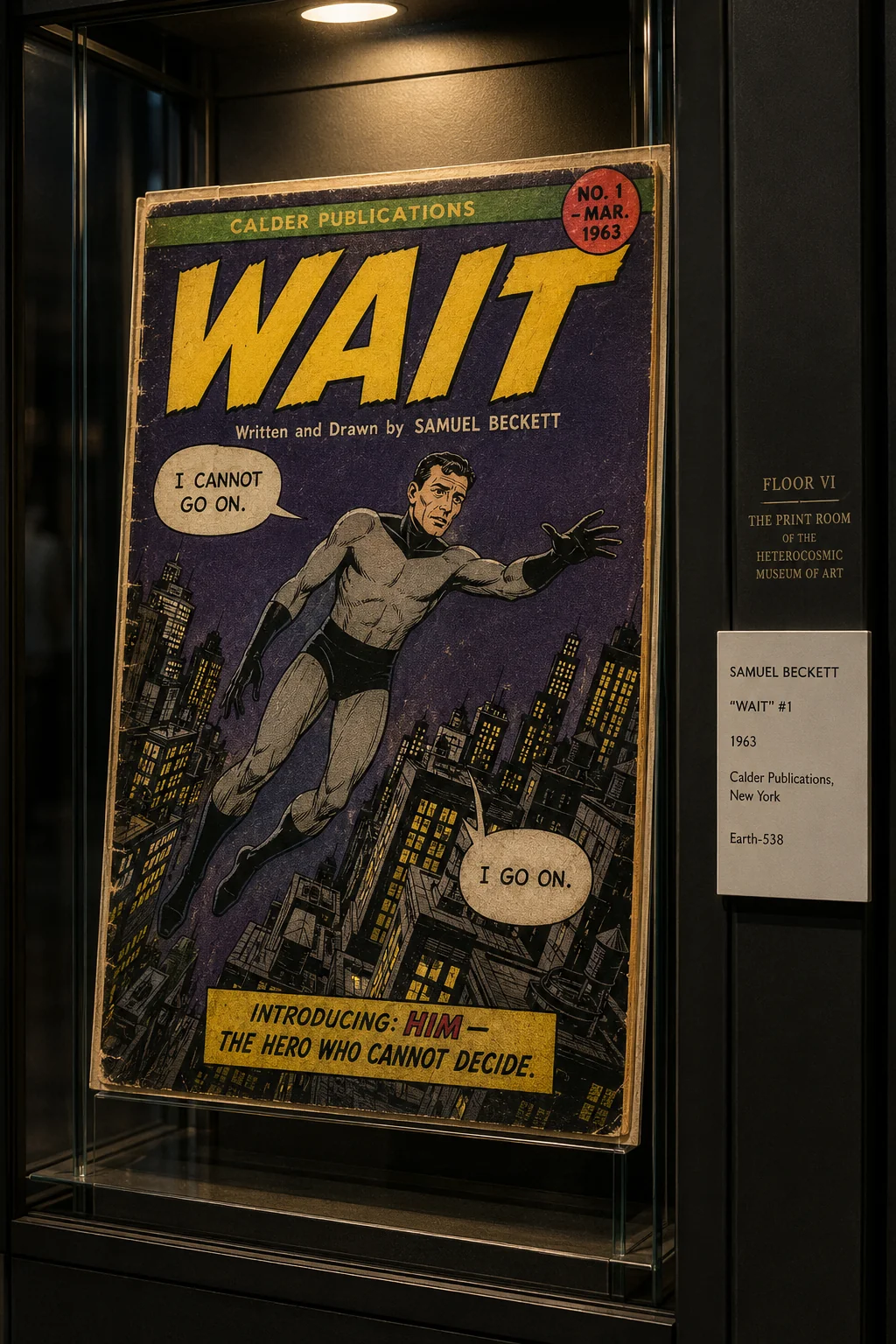
In Earth-538, Samuel Beckett never published a novel and never wrote a play. What he did instead was make comics — alone, in a rented studio on West 28th Street, Manhattan, from 1938 until the year of his death. The critical vocabulary for what he made did not exist when he began and is still contested in Earth-538's academic literature. He called his protagonist 'Him' in all twenty-three series he produced, and Him is always the same person: angular, uncertain, possessed of extraordinary physical power that he deploys with extreme reluctance and sometimes does not deploy at all, in situations where deployment is clearly required. The violence in Beckett's comics is not absent but deferred — held at the edge of the panel, always about to resolve, never quite resolving in the manner the genre promises. Beckett's line — developed over twenty-six years of daily drawing practice — is among the most distinctive in the history of American comics. Readers describe it as 'certain about the wrong things': the edges of objects rendered with absolute precision, the faces of people rendered with a quality of permanent unreadability. His backgrounds contain architectural elements of extraordinary specificity — cornices, fire escapes, iron railings, window frames — placed against voids of pure ink. The effect is of a world that has been partially built and then reconsidered. He gave one interview, in 1971, to an Irish academic named Desmond Donoghue who had tracked him down to his studio. Asked what his comics were about, Beckett said: 'They are about a man who can do anything and is not sure that he should.' He then asked Donoghue to leave, as he was in the middle of a page. The interview was published without Beckett's permission. He did not respond. Beckett produced the twenty-third and final series of WAIT between 1985 and 1989. The last panel — drawn, according to his studio records, on 14 November 1989, three weeks before his death — shows Him standing at a window, looking out at nothing in particular. There is no speech bubble. There is no caption. The window is open.