Click to enlarge
1963 · #1 · 32 pages
WAIT #1
By Samuel Beckett — Explore the real-world artist ↗
| Universe | Earth-538 |
| Year | 1963 |
| Publisher | Calder Publications, New York |
| Genre | Existentialist Superhero |
| Language | English |
| Pages | 32 |
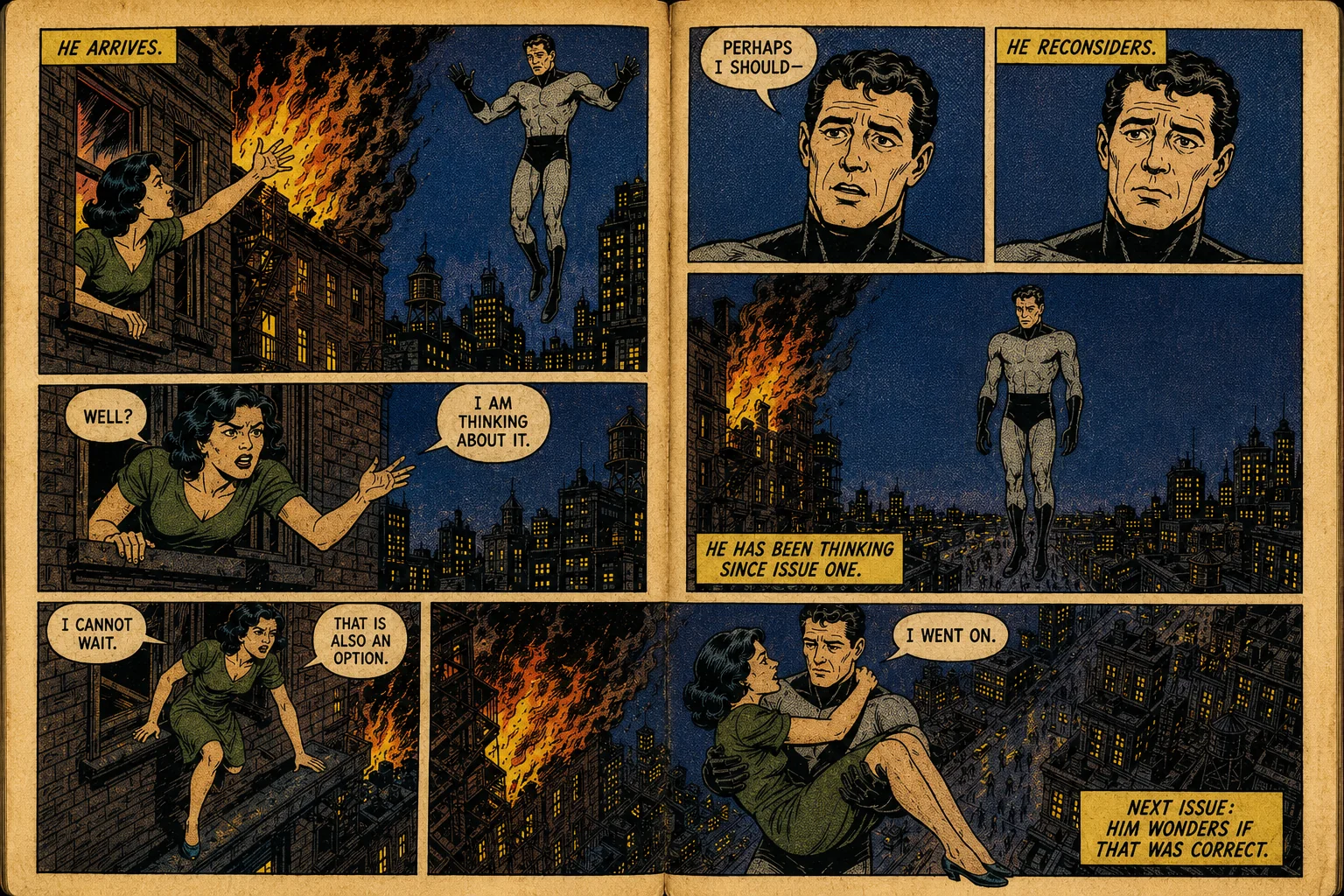
| Exhibited spread | pp. 1–2 |
About the Issue
WAIT #1 opens on a man falling off a building. This is not unusual in the superhero genre. What is unusual is that Him — the series' unnamed protagonist — is already floating beside the falling man by the second panel, having arrived before the fall was complete. The question the first issue asks, in the third panel, in a caption box, is: 'Was it necessary to arrive?'
The falling man is saved in panel four. He does not thank Him. He asks Him what took so long. Him does not answer because, as readers of the subsequent twenty-two series will understand, the question 'what took so long' is the only question the series is prepared to ask seriously.
Beckett's WAIT is formally a superhero comic. Him possesses flight, invulnerability, and strength sufficient to stop a freight train, which he does in issue seven, with an expression that a 1968 New Yorker profile described as 'what a man looks like when he is stopping a freight train and wondering whether it would have stopped anyway.' The supervillains in WAIT are not named. They are not given origin stories. They appear when an antagonist is structurally required and vanish when that requirement is fulfilled. Several of them speak. What they say is not provided.
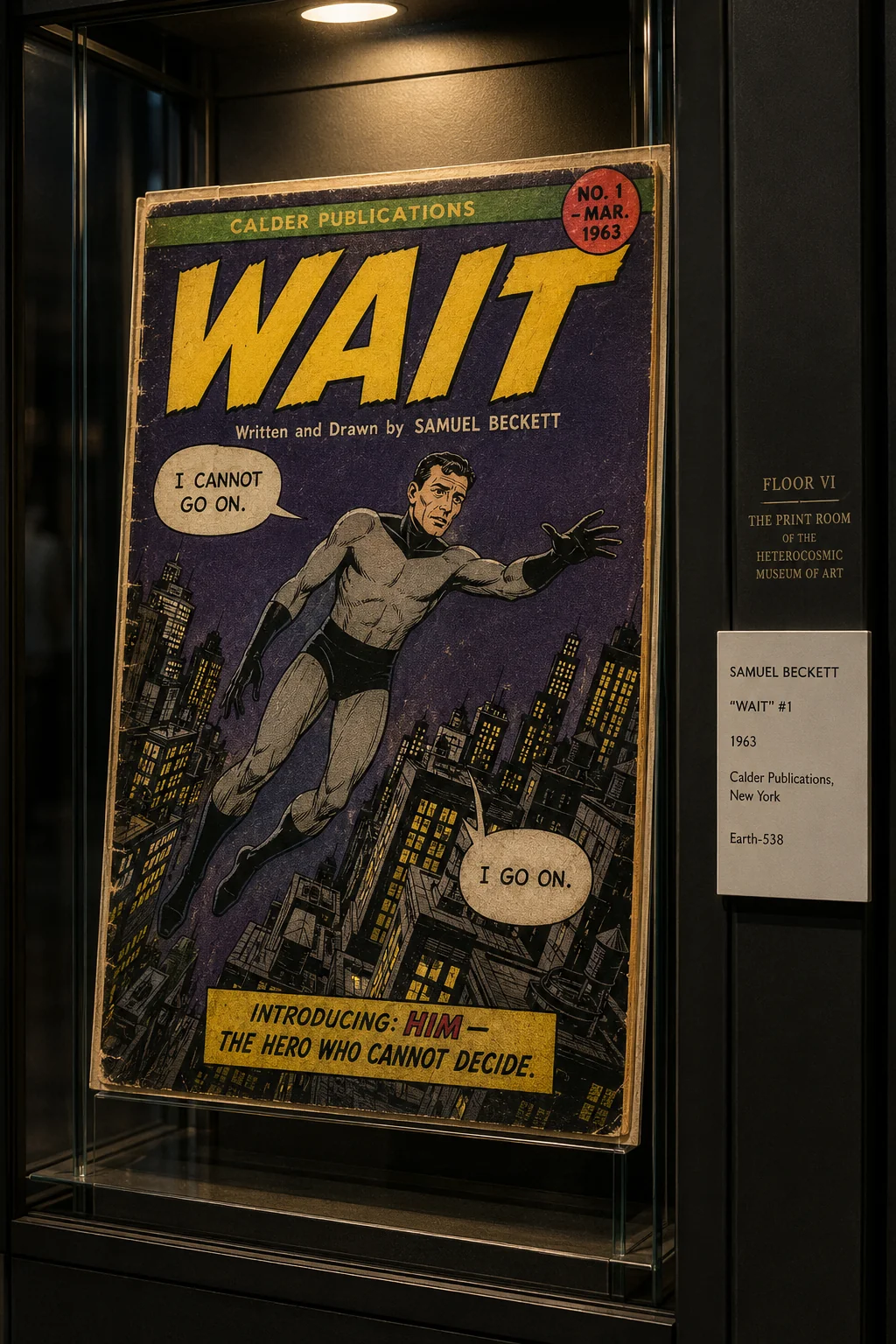
Issue one was published by Calder Publications in March 1963, in a print run of four thousand. John Calder, Beckett's British publisher and the person responsible for establishing the New York imprint that bore his name, had followed Beckett to Manhattan in 1950 and agreed to publish whatever he made. This was a commitment he described in his memoirs as 'the most artistically rewarding business decision I ever made, financially speaking, until 1971 when it wasn't.' Issue one sold 1,200 copies in its first month. By issue twelve, it was selling forty thousand.
The cover of issue one shows Him against the New York skyline, one arm outstretched, one hand open. His expression is the expression Beckett drew on Him's face in every cover of every issue of every series for twenty-six years: attentive, uncertain, and faintly apologetic, as if he is aware that his presence may not help and has come anyway.
The Author in Earth-538
In Earth-538, WAIT is not a superhero comic in the sense that genre readers in our world would recognise. It is a superhero comic in the sense that a man who can fly appears in it regularly and saves people, and that none of this is treated as the point.
The academic literature on WAIT runs to eleven monographs in Earth-538 and is notable for its failure to reach consensus on any significant interpretive question except one: that the series is funnier than it looks. This consensus was established by a 1979 essay by Susan Sontag, who argued that WAIT's comedy was 'not incidental to its meaning but constitutive of it — the funniest thing in it is the genre, and the second funniest thing is that the genre keeps trying to assert itself and keeps being quietly declined.' Beckett, informed of the essay, said he had not read it and did not intend to.
Issue one is considered the founding document of a loose tendency that Earth-538's critics call Reluctant Heroics — a school of comics in which the protagonist's moral uncertainty is not a character flaw to be overcome but the structural condition of the work. Beckett did not coin the term. He did not respond when asked about it. When asked, in 1971, what he thought him was waiting for, he said: 'The same thing everybody is waiting for. He simply has more time in which not to find out.'
Universe Context
A universe in which Samuel Beckett, recovering in Paris from the near-fatal stabbing of January 1938, was sent a parcel of American comic books by an unidentified admirer. In our world, he returned slowly to prose and eventually to theatre. In Earth-538, he did not. He wrote to Thomas MacGreevy in February 1938: 'The images carry what the novel must drag. I have been doing this wrong for twelve years.' He sailed for New York in March. He never published a novel. He never wrote a play. He made comics for twenty-six years, alone, in a studio on West 28th Street, and the body of work he produced is, in Earth-538, considered the most rigorous and the most bewildering thing the American comics form has ever contained.