
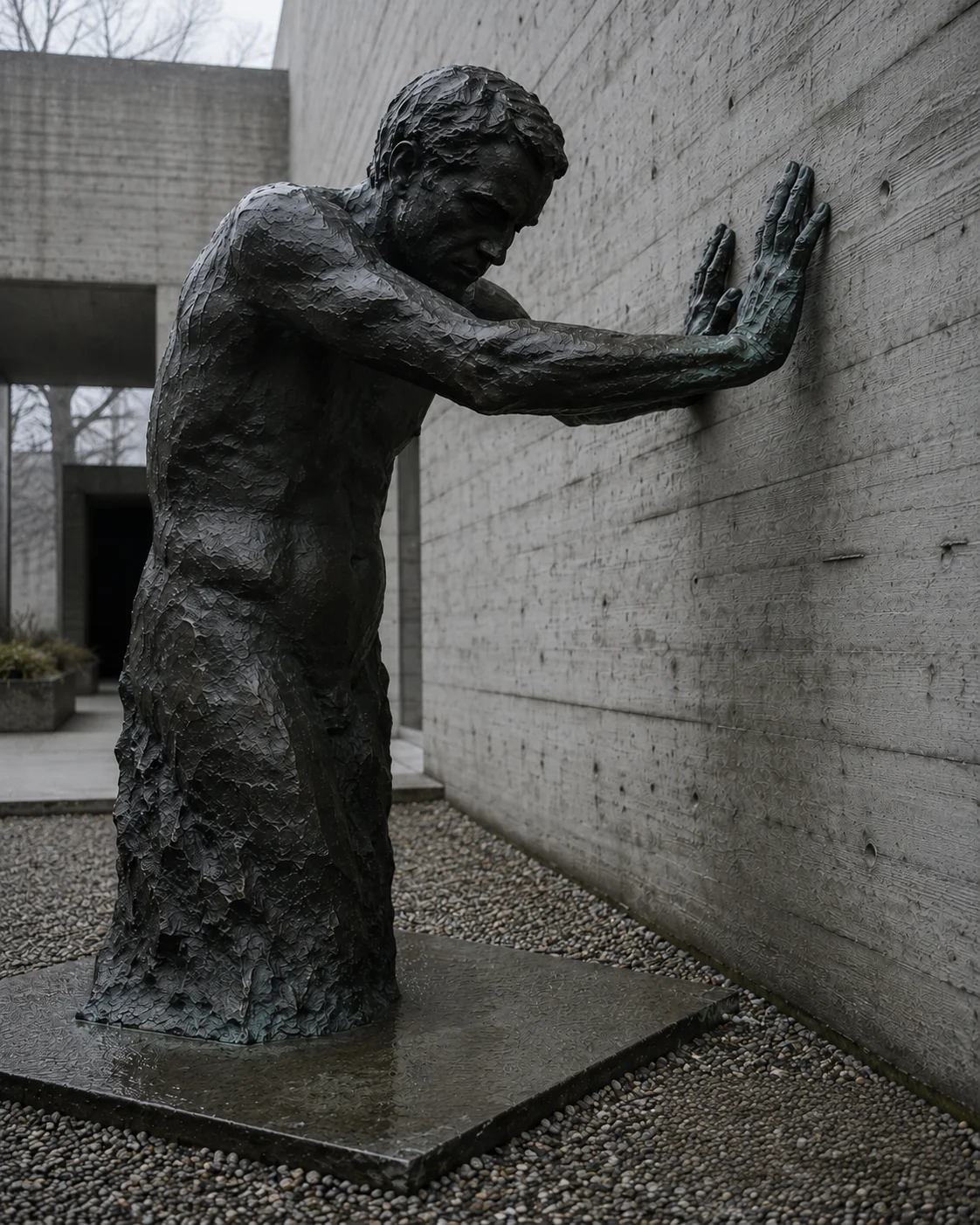
Click to enlarge
1822 · Bronze · 97 × 61 × 52 cm
Das Hören
By Ludwig van Beethoven — Explore the real-world sculptor ↗
| Universe | Earth-527 |
| Year | 1822 |
| Material | Bronze |
| Dimensions | 97 × 61 × 52 cm |
| Location | Sculpture Garden, West Approach — positioned facing the museum wall |
About the Work
A male torso, nearly life-size, leaning forward from the waist with both arms extended, palms flat as if pressed against an invisible surface. The head inclines slightly downward. The eyes are closed — the only point in the figure where Beethoven exercised precision: they are definitively shut, not downcast, not heavy with fatigue, but closed in the specific way of someone concentrating on information that is arriving through a different channel.
The rest of the surface is worked in Beethoven's characteristic manner: the marks of the modelling tools left visible in the bronze, planes that do not smooth into each other, areas of the torso that appear to have been compressed rather than built. The hands are the most carefully resolved part of the work. The fingers are slightly spread, the palms slightly cupped — not grasping, not bracing, but open to receive whatever the invisible surface might transmit.
The invisible surface is not represented. It exists only as the implied reason the figure does not fall forward — a resistance, a push-back, something that returns pressure. Beethoven's notebooks from the period of the work's making contain a single notation that may refer to it: 'the wall knows more than the ear.' He did not elaborate.
'Das Hören' was modelled in 1822 and cast in bronze three years later. Beethoven described it in correspondence as a study — a term he applied to roughly a third of his works, apparently without consistent meaning. It is the piece most frequently cited by critics in Earth-527 as the clearest statement of his central question: whether something can be felt in place of heard, and whether the feeling is the same thing, or only the same shape.
The Sculptor in Earth-527
In Earth-527, Beethoven lost his hearing completely at twenty-seven following a fever in 1797. He abandoned composition in 1800, moved to Rome in 1801, and began working in clay without formal training. He studied briefly under Canova before returning to Vienna in 1810, where he worked for the remaining forty-four years of his life. His sculptures are bodies in the act of receiving — pressed against surfaces, waiting for vibration to arrive through material the ear can no longer carry. He died in 1854, aged eighty-three, having produced forty-three works. He is the alternate-world counterpart of the composer who wrote the Ninth Symphony deaf.
Universe Context
A universe in which Beethoven's deafness arrived in 1797, twenty years earlier than in ours, and with a completeness that allowed no adaptation. The divergence is medical: a fever caused nerve damage that progressed to total hearing loss within six months. In Earth-527, Beethoven is known not as a composer but as a sculptor — one of the defining sculptors of the early nineteenth century, whose forty-three works, produced in Rome and Vienna between 1801 and 1854, constitute one of the most sustained investigations of tactile perception in the history of European art.